
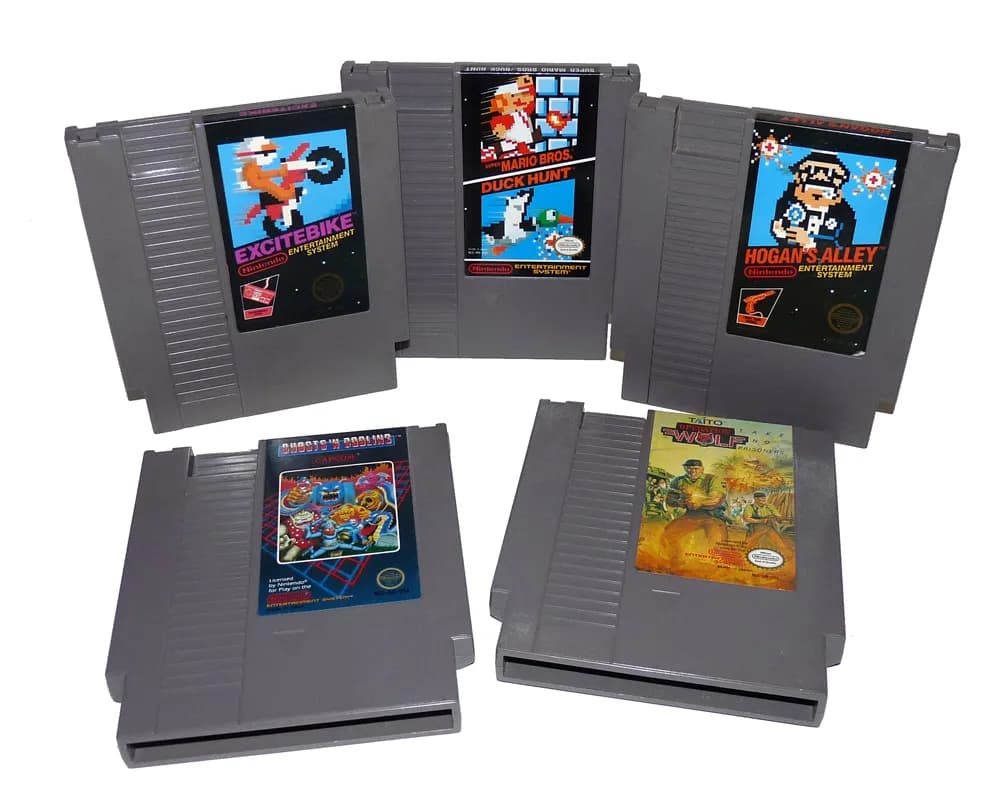
NES games come in cartridges, and inside of those cartridges are various circuits and hardware. Different games use different circuits and hardware, and the configuration and capabilities of such cartridges is commonly called their mapper. Mappers are designed to extend the system and bypass its limitations, such as by adding RAM to the cartridge or even extra sound channels. More commonly though, mappers are designed to allow games larger than 40K to be made. The term mapper arises from the concept of memory mapping: translating memory hardware into the CPU's and PPU's address spaces. A memory map describes which addresses correspond to which physical locations of memory.
The MMC3 Mapper
The Nintendo MMC3 is a mapper ASIC used in Nintendo's TxROM Game Pak boards. Most common TxROM boards, along with the NES-HKROM board (which uses the Nintendo MMC6), are assigned to iNES Mapper 004. The MMC3 has 4 pairs of registers at $8000-$9FFF, $A000-$BFFF, $C000-$DFFF, and $E000-$FFFF - even addresses ($8000, $8002, etc.) select the low register and odd addresses ($8001, $8003, etc.) select the high register in each pair. These can be broken into two independent functional units: memory mapping ($8000, $8001, $A000, $A001) and scanline counting ($C000, $C001, $E000, $E001). The MMC3 scanline counter is based entirely on PPU A12, triggered on a rising edge after the line has remained low for three falling edges of M2. The counter is based on the following trick: whenever rendering is turned on in the PPU, it fetches nametable and BG pattern tiles from dots 0-255 and 320-340 of a scanline and fetches sprite patterns from dots 256-319, even if no sprites are visible. Because of this, if BG uses the left pattern table ($0000), and if sprites always use the right pattern table ($1000), this filtered copy of A12 will remain low during all nametable and BG pattern fetches, and high during all sprite pattern fetches, causing it to oscillate exactly one time per scanline and 241 times per frame. It may oscillate more if the program uses registers $2006 and $2007 to access PPU $1000-$1FFF during vblank, but this is rare because very few games have MMC3 and CHR RAM (two on TQROM and three on TGROM among NES games, and a couple more Famicom-only games). The scanline counter partially works when the BG uses the right pattern table ($1000) and the sprites use the left pattern table ($0000), but the missing dot on the 2C02 causes the very first scanline to sometimes count twice. The MMC3 IRQ has two revisions that work slightly different. In NES games, the MMC3 is the second most frequently used mapper.
The MMC1 Mapper
The Nintendo MMC1 is a mapper ASIC used in Nintendo's SxROM, NES-EVENT and 2ME circuit boards. Unlike almost all other mappers, the MMC1 is configured through a serial port in order to reduce its pin count. CPU $8000-$FFFF is connected to a common shift register. Writing a value with bit 7 set ($80 through $FF) to any address in $8000-$FFFF clears the shift register to its initial state. To change a register's value, the CPU writes five times with bit 7 clear and one bit of the desired value in bit 0 (starting with the low bit of the value). On the first four writes, the MMC1 shifts bit 0 into a shift register. On the fifth write, the MMC1 copies bit 0 and the shift register contents into an internal register selected by bits 14 and 13 of the address, and then it clears the shift register. Only on the fifth write does the address matter, and even then, only bits 14 and 13 of the address matter because the mapper doesn't see the lower address bits (similar to the mirroring seen with PPU registers). After the fifth write, the shift register is cleared automatically, so writing again with bit 7 set to clear the shift register is not needed. When the serial port is written to on consecutive cycles, it ignores every write after the first. In practice, this only happens when the CPU executes read-modify-write instructions, which first write the original value before writing the modified one on the next cycle. This restriction only applies to the data being written on bit 0; the bit 7 reset is never ignored. At least seven different versions of the MMC1 are known to exist: MMC1, MMC1A, MMC1B1, MMC1B1-H, MMC1B2, MMC1B2F, MMC1B3. The known differences relate to bit 4 of $E000. In NES games, the MMC1 is the most common among the mappers.